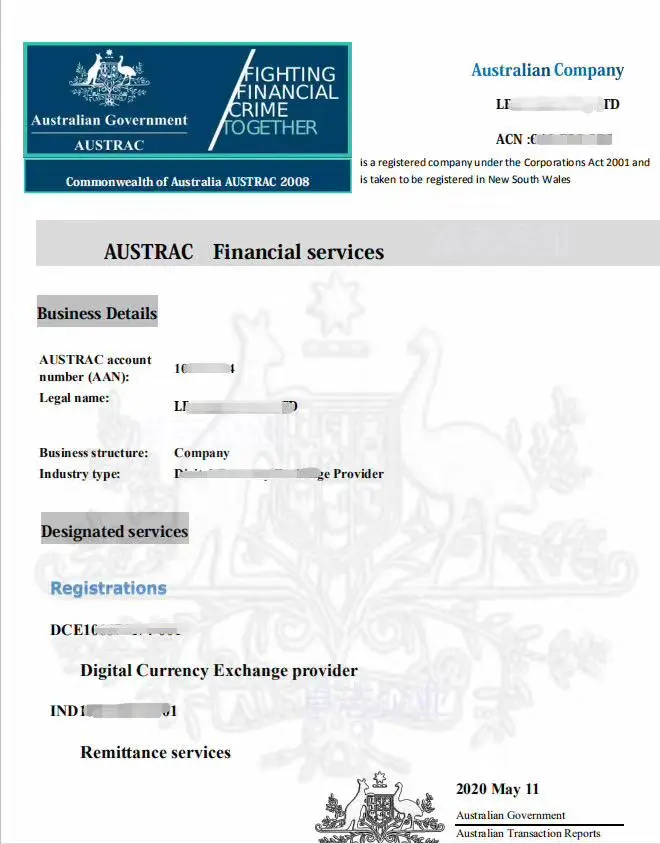

What is the Australian AUSTRAC payment license? (Regulatory positioning)
definition: It is a statutory compliance qualification approved under Australia’s Anti-Money Laundering and Counter-Terrorist Financing Act 2006 (AML/CTF Act)。After completing this registration,Licensed institutions are allowed to operate the following core payment businesses:
- 1、Cross-border transfer (Remittance): Provide customers with international or domestic fund transfers。
- 2、Currency Exchange: Operate trading services in different legal currencies (such as US dollars for Australian dollars)。
- 3、Payment Processing: Provide fund settlement and payment gateway services for e-commerce or B2B trade。
Digital Currency Exchange (DCE): Offers cryptocurrencies and fiat currencies、or exchange between different cryptocurrencies。regulatory agency
regulatory agency:
Australian Financial Transaction Reports and Analysis Center (AUSTRAC)。As Australia’s top financial intelligence and anti-money laundering agency,AUSTRAC is responsible for monitoring the trading practices of licensed institutions,Ensure that all currency exchange and remittance activities comply with strict anti-money laundering (AML) and counter-terrorism financing (CTF) requirements,Prevent financial crime。
Important reminder:The AUSTRAC system solvesAnti-Money Laundering Compliance Access and Ongoing Obligations。If the business involves financial products/investment advice、deposit、信用、Payment facilities etc.,ASICs may also be involved、Other regulatory frameworks such as APRA (whether AFSL, etc. are required requires separate business mapping)。
What businesses must connect with AUSTRAC? (Application scope and typical scenarios)
Provide international remittances、Collection and payment for customers、Fund transfer services through agent/merchant network,Typically required to complete AUSTRAC enrolment,And complete RSP registration according to the nature of business。
Engage in legal currency ↔ digital currency exchange、Matchmaking and brokerage (subject to transaction settlement and customer relationship),It is generally necessary to register with DCE and establish on-chain/off-chain monitoring and evidence collection capabilities.。
The common platform model "looks like technical services"、The boundary issue of "actually serving funds"。Required from capital flow、contract chain、KYC ownership and control rights are used to make business substantive judgments.。
When using a proxy、When expanding customers through white label or multi-tier channels,AUSTRAC’s response to “Who has AML/CTF obligations?”、who submits report、Who keeps records” requirements are more stringent,The division of responsibilities and evidence chain need to be clearly defined。
We recommend that the judgment of “whether AUSTRAC registration/registration is required” be broken down into three steps:
- Business substance mapping:Are the funds under your control/direction? Initiate/receive/transfer funds or value on behalf of a client?
- Customer relations and due diligence responsibilities:Who completes KYC? Who owns customer files and transaction monitoring?
- Transaction reporting and record retention:Who reports to AUSTRAC (e.g. suspicious matters、Threshold transactions, etc.)? Who can provide a complete chain of evidence during the audit?
List of Core AML/CTF Obligations (Key Points to Look at in Bank Due Diligence Meetings)
Complete enrollment/registration is just the starting point。AUSTRAC’s supervisory and partner banks’ due diligence typically focuses on the following “demonstrable、traceable、Sustainable” capacity building:
- AML/CTF Program:governance structure、Division of responsibilities、risk appetite、training、independent review mechanism;
- Risk Assessment:Customer/product/channel/region/transaction scenario risk stratification,Develop control measures that can be implemented;
- Customer Identification & Verification (customer identification and verification):Personal/Business KYC、Beneficial owner identification、PEP/Sanctions and Adverse Media Screening;
- Ongoing Due Diligence:Customer information update、behavioral deviation identification、event driven review;
- Transaction Monitoring:Closed loop of rules + model + manual review,Contains alarm diversion、upgrade、Disposal and evidence solidification;
- Reporting (statutory reporting):Suspicious Matter Report (SMR/STR)、Threshold Transaction Report (TTR,if applicable)、International Funds Transfer Instructions Report (IFTI,If applicable) etc.;
- Record Keeping:KYC、trade、Alarm、Investigation conclusion、Report submission vouchers and approval records,Meet retention periods and retrieval。
If you need to quickly commercialize the above capabilities,We usually combine KYC identity verification system and transaction monitoring system,And supporting compliance system and evidence collection template,Make sure you “can do it” and “have evidence”。
AUSTRAC application/registration process (from business mapping to operational)
Sort out the capital flow/contract flow/information flow,Confirm whether it constitutes a "regulated service",and assess whether other Australian regulatory requirements are involved.。
Check AML/CTF Obligations List,identification system、system、personnel、Outsourcing and data retention gaps。
Establish AML/CTF Program、risk assessment、KYC/EDD、Sanctions and Lists、Handling suspicious matters、Training and Independent Review Program。
Configure KYC、List screening、Transaction monitoring、Alarm handling、Report submission process and audit log;Form an exportable forensics package。
Complete regulatory inclusion and (if applicable) RSP/DCE registration,and tie reporting obligations and internal controls to day-to-day operations。
Perform training on a periodic basis、Sampling review、Independent review and model tuning;Ensure major changes (product/market/channel) trigger re-evaluation。
If your goal is to "go online with compliance + Can open an account + Can be connected to clearing/channel”,It is recommended that project deliverables be clearly divided into three categories:
- regulatory explainability:system、risk assessment、Reporting and retention meet AUSTRAC inspection logic;
- bank acceptability:KYC/EDD Strength、Transaction monitoring coverage、Governance of suspicious matters and management involvement;
- operational sustainability:able to grow in business、Channel expansion、Don’t lose control when agents join,and can continue to prove effective。
Related cross-border structures and corridor planning,Synchronizable reference:Cross-border payment solutions and Cross-border business compliance。
Costs and budgets:AUSTRAC vs Hong Kong MSO (Benchmarking Reference)
AUSTRAC-related government-side fees are usually not presented in the "license application fee" model,The company's main investment is concentrated inCompliance system、System capabilities、People and Independent Review。Prepare budgets to facilitate the board of directors and finance,we provide aBenchmark Hong Kong MSO (for cost structure reference only)cost matrix,Help understand the ratio of "government costs vs compliance costs"。
| cost category | Typical projects | Reference interval (HKD) | Remark |
|---|---|---|---|
| Gov (Government Expenses) | Application | 3,310 | reference:Hong Kong MSO application fee |
| Gov (Government Expenses) | Fit&Proper (per person) | 860 / people | reference:Hong Kong MSO Fit and Proper Review |
| Base (basic construction) | Company registration、secretary、Basic legal affairs | 8,000 – 15,000 | reference:Hong Kong MSO Cost Structure;Australia actually mainly focuses on structure and consulting fees |
| Base (basic construction) | Office and basic operations | 20,000 – 80,000 / Year | reference:Hong Kong MSO;Australia can be adjusted according to actual office and staffing configuration |
| Agency (Consultancy and Delivery) | MSO Service (overall application/compliance implementation) | 60,000 – 150,000 | reference:Hong Kong MSO agency service;AUSTRAC projects usually focus on compliance implementation and operational preparation |
| Agency (Consultancy and Delivery) | AML documents and systems (including risk assessment) | 20,000 – 80,000 | reference:Hong Kong MSO;AUSTRAC places greater emphasis on continuous due diligence and closed-loop reporting |
| Total | standard interval | 150,000 – 400,000 | reference:Hong Kong MSO Common Total Costs;AUSTRAC project budget needs to be integrated with the system、Personnel and business complexity will be calculated separately |
If you want to align budget with deliverables (e.g.:System selection、Model coverage、independent review frequency、Agent network control intensity),It is recommended to do a "business mapping" first + Compliance Gap Assessment”。Available from Fintech Compliance Consulting start。
Common difficulties and compliance implementation suggestions (adapted to B2B cooperation and auditing)
It is recommended to create a “DD Pack”:Company structure、AML/CTF Program、risk assessment、KYC sample、Monitoring rules list、SMR disposal process、Independent Review Plan and Sample Report。
Clear at the contract level:Who does KYC、Who does the monitoring?、who submits report、Who keeps records;Establishing agent access at the operational level、training、Sampling inspection and exit mechanism。
Address on the chain、transaction hash、Funding source description、risk score、Alarm handling opinions form a closed loop;Ensure conclusions can be reviewed in regulatory/audit contexts。
External publicity needs and actual service capabilities、Consistent risk disclosure;It is recommended to conduct a marketing compliance review before going online,Avoid high-risk statements such as "guaranteed income/no risk"。
Supporting service suggestions:
- External publicity and product launch:Marketing material review
- Data and log compliance:Data security assessment、Personal information protection
- If you need to synchronize layout accounts in different regions:Can be referenced Offshore bank account opening and Singapore bank account opening due diligence ideas and information preparation direction (subject to actual bank requirements)。
FAQ:AUSTRAC registration high frequency issues
AUSTRAC is mainly AML/CTF regulatory registration and (specific business) registration,Not equivalent to a business license covering all financial businesses。Whether it can be operated also depends on the nature of the business、liquidation arrangements、Bank/channel access and other regulatory requirements (if financial products are involved, additional assessment may be required)。
RSP focuses on fund/value transfer (remittance) business;DCE focuses on legal currency and digital currency exchange business。If the enterprise also provides related services,Registration and AML/CTF obligations generally need to be assessed separately and may be met simultaneously。
usually include:Is the risk assessment appropriate for the business?;Is KYC/UBO penetrable?、Verifiable;Whether transaction monitoring and alarm handling form an evidence chain;Are suspicious matters evaluated and reported according to procedures?;Are the records retained complete and retrievable?;Are training and independent reviews carried out as planned?。
Technically feasible,But for the "compliance officer"、The availability and response speed of "daily operations and independent review" need to be designed in advance。Due diligence between banks and partners often requires a clear division of responsibilities.、Escalation mechanism and compliance contacts who can be contacted。
Regulatory logic emphasizes “effectiveness” rather than fixed tool form。If the trading volume、Product complexity and risk exposure are high,Lack of systematic monitoring will make it difficult to demonstrate the effectiveness of continuous due diligence,It will also significantly affect the bank/channel due diligence pass rate。
It is recommended to start from the capital flow and customer journey,Unify customer stratification、List screening、Monitoring model、Alarm handling and evidence collection;and align with multi-jurisdictional requirements。Can combine "cross-border business compliance" and "fintech compliance consulting" to create an overall plan。
Australian AUSTRAC payment license - sample